


[ad_1]
TOKYO, Mar 7, 2022 – (JCN Newswire) – Fujitsu and the Tokyo Medical and Dental University (TMDU) today announced a new technology that uses AI to discover new causal mechanisms of drug resistance in cancer treatments from clinical data. Leveraging the world’s fastest supercomputer “Fugaku,”(1) the new technology enables high-speed calculation of 20,000 variables of data within a single day and allows for the discovery of previously unknown causal relationships relating to drug resistance in cancer cells from 1,000 trillion different possibilities.
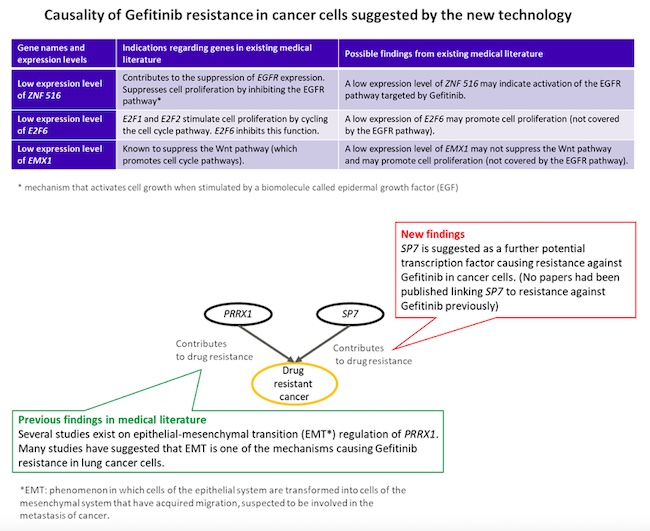 |
Fujitsu and TMDU applied this technology to gene expression level(2) data obtained from cancer cell lines in order to analyze drug resistance(3) against anticancer drugs, and succeeded in extracting a new causal mechanism of a previously unknown gene that suggests a cause of resistance to lung cancer drugs. The new technology is expected to contribute to the acceleration of drug discovery and the realization of cancer therapies individualized for each patient.
The technology was developed under the theme of “elucidation of the cause and diversity of cancer using large-scale data analysis and AI technology,” an initiative supported by TMDU, Kyoto University and Fujitsu as part of the supercomputer Fugaku achievement acceleration program(4) .
Background
Even if a patient receives a targeted cancer drug(5) therapy, the appearance of drug-resistant cancer cells represents an ongoing threat to full remission. The mechanism for how certain cancers become drug resistant remains unclear, however, and researchers continue to work on new methods of analysis that shed light on how cells that have multiple driver mutations(6) acquire drug resistance. In drug development and clinical trials involving drug repositioning(7), it is important to identify patients for whom drugs are anticipated to have an effect . However, the effectiveness of drugs may differ depending on the organ and the individual and variations in gene expression, and the number of patterns combining expression levels of multiple genes exceeds 1,000 trillion(8). A comprehensive search of all 20,000 genes in the human genome would thus take more than 4,000 years with a conventional computer and finding ways to accelerate the process represents a major challenge.
Newly developed technology
Fujitsu implemented parallel conditional and causal algorithms to maximize computational performance with the supercomputer Fugaku to analyze the human genome within a timeframe needed for practical research. By utilizing Fujitsu’s “Wide Learning”(9) AI technology to extract combinations of potential genes relating to the emergence of drug resistance based on statistical information, Fujitsu developed a…
Full story available on Benzinga.com
[ad_2]
Source link
